8th Pay Commission: New Salary Hike Details, Panel Members, Fitment Factor and Expected Benefits
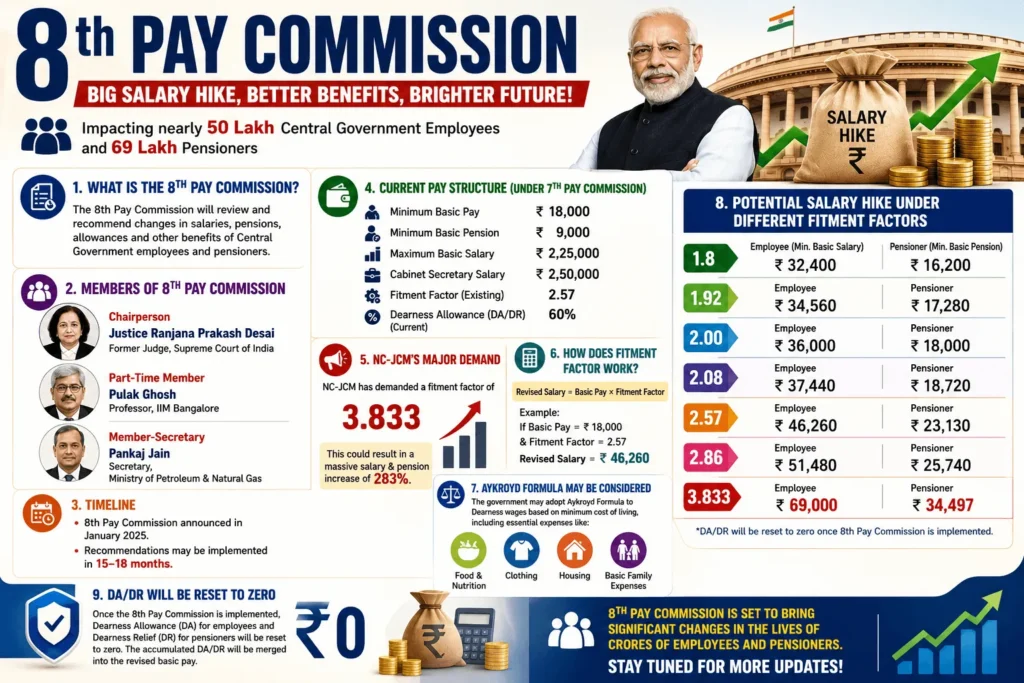
The 8th Pay Commission has become one of the most discussed topics among Central Government employees and pensioners. The Union Cabinet, led by Prime Minister Narendra Modi, has approved the Terms of Reference for the 8th Pay Commission and officially notified the new commission. The recommendations are expected to impact nearly 50 lakh Central Government employees, including Defence personnel, and around 69 lakh pensioners across India.
1. What is the 8th Pay Commission?
The 8th Pay Commission is a government-appointed body responsible for reviewing and recommending revisions to salaries, pensions, allowances, and other benefits for Central Government employees and pensioners. The commission aims to ensure compensation remains aligned with inflation and living costs.
2. When Was the 8th Pay Commission Announced?
The Central Government announced the formation of the 8th Pay Commission in January 2025. The commission has been established to examine existing pay structures and recommend suitable revisions for government employees and retirees.
3. Members of the 8th Pay Commission Panel
The Government has appointed the following members to lead the 8th Pay Commission:
- Chairperson: Justice Ranjana Prakash Desai
- Part-Time Member: Pulak Ghosh
- Member-Secretary: Pankaj Jain
These officials will prepare recommendations regarding salary and pension revisions.
4. Expected Timeline for 8th Pay Commission Implementation
The 7th Pay Commission recommendations were approved and implemented within approximately six months. Based on a similar timeline, experts estimate that the 8th Pay Commission recommendations could be implemented within the next 15 to 18 months.
5. Current Salary Structure Under the 7th Pay Commission
At present, Central Government employees receive salaries under the 7th Pay Commission structure:
- Minimum Basic Pay: ₹18,000 per month
- Minimum Basic Pension: ₹9,000 per month
- Maximum Basic Salary: ₹2,25,000 per month
- Cabinet Secretary Salary: ₹2,50,000 per month
- Existing Fitment Factor: 2.57
- Current DA/DR: 60%
6. NC-JCM’s Major Demand for the 8th Pay Commission
The Staff Side of the National Council Joint Consultative Machinery (NC-JCM) has submitted a 51-page memorandum to the 8th Pay Commission. One of its biggest demands is a fitment factor of 3.833.
If approved, this could result in a substantial increase in salaries and pensions for over 1.2 crore beneficiaries.
7. How Does the Fitment Factor Work?
The fitment factor is used to calculate revised salaries and pensions under the 8th Pay Commission.
Formula:
Revised Salary = Basic Pay × Fitment Factor
For example, an employee earning ₹18,000 basic pay would receive a revised salary based on the approved fitment factor.
8. Aykroyd Formula May Influence 8th Pay Commission Recommendations
Experts believe the Government may consider the Aykroyd Formula while determining salary revisions.
Developed by Dr. Wallace Aykroyd, the formula calculates wages based on minimum living costs and essential requirements such as:
- Food and nutrition
- Clothing
- Housing
- Basic family expenses
This approach focuses on ensuring employees receive adequate compensation to maintain a reasonable standard of living.
9. Potential Salary Hike Under Different Fitment Factors
Several fitment factor scenarios are being discussed for the 8th Pay Commission.
Fitment Factor 1.8
- Minimum Salary: ₹32,400
- Minimum Pension: ₹16,200
Fitment Factor 1.92
- Minimum Salary: ₹34,560
- Minimum Pension: ₹17,280
Fitment Factor 2.00
- Minimum Salary: ₹36,000
- Minimum Pension: ₹18,000
Fitment Factor 2.08
- Minimum Salary: ₹37,440
- Minimum Pension: ₹18,720
Fitment Factor 2.57
- Minimum Salary: ₹46,260
- Minimum Pension: ₹23,130
Fitment Factor 2.86
- Minimum Salary: ₹51,480
- Minimum Pension: ₹25,740
Fitment Factor 3.833
- Minimum Salary: ₹69,000
- Minimum Pension: ₹34,497
10. What Happens to DA and DR After 8th Pay Commission?
Once the 8th Pay Commission is implemented, Dearness Allowance (DA) for employees and Dearness Relief (DR) for pensioners are expected to be reset to zero. The accumulated DA/DR is generally merged into the revised basic pay before the new salary structure takes effect.
Conclusion
The 8th Pay Commission is expected to bring significant changes to the salary and pension structure of Central Government employees and pensioners. While the final fitment factor and recommendations are yet to be announced, salary increases could range from moderate to substantial depending on the government’s decision. With millions of employees and retirees waiting for the outcome, the 8th Pay Commission remains one of the most important developments in India’s public sector compensation system.
About the Author